
Same Pea, Different Pod
"You're an amateur." A meme comparing Jim Jones to Fauci sparked a deep dive into false doctrine, word of faith deception, and why Satan, as they put it, has no creative power of his own, just old lies in new packaging.


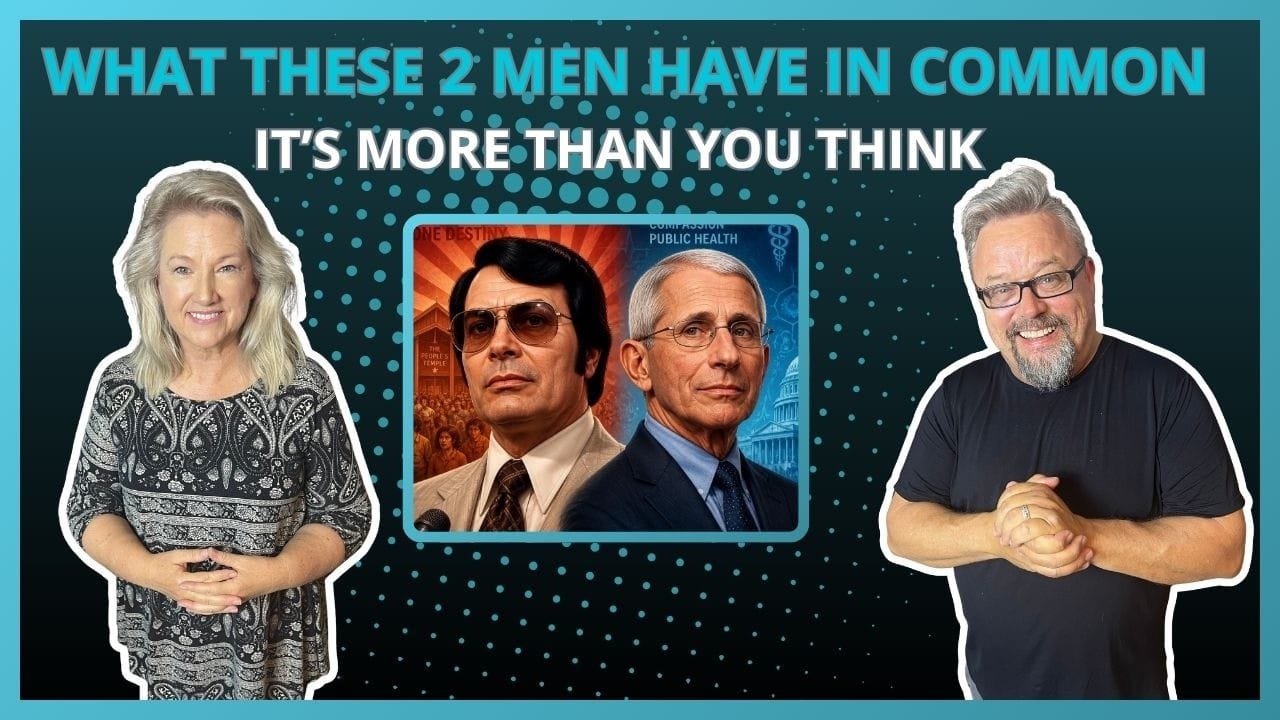
Watch
Listen
Click here to listen to the episode on our website
Read
There's a meme going around that Chris and Emilee can't stop thinking about. Two men, side by side. The Reverend Jim Jones says, "I got 900 people to drink the poison Kool-Aid." Anthony Fauci says, "You're an amateur."
It's the kind of image that lands a punchline before you've even processed it. But for the hosts of No Apology, the joke is really an argument, and they spend the episode making the case, in their own words, for why they see these two men as "two horses on the same team pulling that cart forward." That cart, as Emilee puts it, is false doctrine, and the destination is overcoming the saints. She ties the framing directly to Revelation 13 and 14, where two beasts, one political and one religious, rise up together before eventually overcoming the saints. That, she says, is what the meme is really tapping into, whether the people sharing it realize it or not.
"You don't even have to be a Christian to catch the irony there," Chris says. "But the fact of the matter is these are two sides of the exact same coin." Emilee names the coin outright: humanism. What follows is their attempt to defend that claim, part history lesson, part cultural commentary, part sermon, and it's worth saying plainly up front that a good deal of what's below is opinion and interpretation on their part, not documented fact, particularly where Fauci is concerned.
Who Was Jim Jones, Really?
Before the connection to Fauci gets made, Emilee wants to establish who Jim Jones actually was, because she suspects most people only know the ending of the story (the poison, the jungle, the 900 bodies) without the decades that led there.
Jones grew up during the Depression, poor, with parents who were "largely absent." Neighbors would find him wandering the town naked and hungry, and it was the townspeople, including people from local churches, who fed and clothed him. As a kid, he gravitated hard toward Pentecostal religion, and by all accounts he was fixated early. He didn't just want to attend church, he wanted to be the preacher.
That fixation curdled into something stranger. Jones came to believe, as a child, that he had supernatural powers, including the belief that he could fly. "He broke his arm trying to fly," Emilee says, "but that still didn't deter him." She draws a straight line from that childhood delusion to something she and Chris see everywhere today: rational thought "kind of goes out the window" once someone commits to believing something contrary to the evidence in front of them. Chris agrees immediately. "We're seeing it everywhere," he says. "Rational thought, just common sense, people are starting to lose their minds in certain areas." He admits he's watched people he never expected to lose their composure do exactly that, and he's honest enough to say he loses his own composure more than he'd like to admit. He calls it "the darkness that's been coming over society since 2014."
That date isn't random to Chris. He points to the moment the White House lit up in rainbow colors the night the Supreme Court's marriage ruling came down, a display he says had to have been planned days in advance. "We have never been the same nation since," he says. "We've been under God's judgment." He connects this to Ephesians 6:12, the idea that once "this present darkness" takes hold, even close friends get pulled into it without realizing it, saying and doing things that aren't Christlike while giving credit back to God for it. For Chris, that's the core problem with false doctrine: it insists that ungodly behavior is actually God's will, that confirmation is coming from above when it plainly isn't.
By 1956, Jones was formally ordained as a minister in the Independent Assemblies of God church. That's where his own ministry, and the cult that would eventually become the People's Temple, really took root. And notably, Emilee points out, he didn't build his following by going out and evangelizing the lost. He built it by pulling people out of other churches. "Taking people who are easily deceived from church, who are already kind of in the Christian circles," as she describes it. It's a pattern she and Chris come back to again and again through the episode: false teaching doesn't usually recruit from scratch. It poaches.
Along the way, Jones picked up some strange company. A woman in the "latter rain" movement once stood up in a Pentecostal service and prophesied over him, declaring he'd be a great teacher, preacher, a prophet. "When someone tells you God told you that," Emilee says, "what do you do? Say no? You're a young kid, you just say no." It's a moment she frames as the seed of everything that followed: a false doctrine wrapped in the language of divine confirmation, which makes it almost impossible to argue against. "They pretend it's from God," she says, "because then you have a harder time arguing against it."
Chris connects this straight to the modern word of faith and charismatic movement, and he doesn't soften it. Over the last decade plus, accelerated by YouTube since roughly 2007 to 2015, he says the two of them could probably scrape together fifty to a hundred testimonies of people massively hurt, spiritually or physically, some even killed, by the teaching that enough faith can get you anything. Plant your seed, get your harvest. "The God of the universe, who created you, who can count the hairs on your head, who sent his son to die for your sins," Chris says, "his blessings are all blocked and locked up until you give this dude money." He calls it foolish on its face, and yet, he says, "good people" (his air quotes) fall for it constantly, because it's a doctrine from the enemy, "the great liar, the great manipulator, the great deceiver." Jones, in his words, was one of Satan's "top dudes." Emilee adds the practical mechanics of how a con like this survives: "He must have been getting results, because they're pragmatists. They just base it all on what they can see. Oh, he prayed and planted a seed and got rich, so it should work for me. Oh, it didn't work for me, my faith must be bad."
Heat's On, Time to Relocate
Eventually, the press and outside observers started noticing that something was off with Jones's "healing revivals." Word got out about abuses. The scrutiny increased. And according to Emilee and Chris, Jones's response to scrutiny is where the real parallel to Fauci begins.
"He didn't like it," Emilee says. "So what did he do? He packed it all up, shut her all down in the United States, and he made way to Guyana." That's where Jonestown was built, a communist commune set up specifically, in her telling, to get out from under American oversight.
This is the point in the conversation where Chris draws the comparison that anchors the whole episode, and it needs to be said clearly: this is his interpretation, not an established or verified fact. Chris connects Jones's relocation to Guyana with allegations, long circulated in some corners of conservative and anti-vaccine media but not established as fact, that Fauci-linked research was moved to a lab in Wuhan after U.S. authorities raised concerns about the work being done domestically. "That sounds a lot to me like Fauci," Chris says, "when he had those labs where they were trying to do these experiments with bacteria and stuff, and the United States government said, 'Hey, hey, hey, you cannot do that.' So what did Fauci do? Packed it all up, and they moved that lab to Wuhan."
There's a genuine moment of crossed wires here that's worth keeping because it shows how the two of them build the case out loud, in real time. Emilee initially mishears the claim, thinking Chris means authorities came to Guyana after the deaths and moved Jones's own operation to Wuhan. "No," Chris clarifies, "I said like Fauci," and once she catches up, her reaction is half genuine outrage, half self-aware comedy: "Can I just do stuff? I got money. Could it hurt the American people? Yeah. Yes. Okay. Sure." It's a bit, but it's also the thesis. In their view, both men, when faced with accountability, didn't stop, they simply moved somewhere the accountability couldn't follow. "Heat's on, I got to go to some obscure place," Chris summarizes, and Emilee agrees that's the parallel: the government tried to shut down work it found objectionable, and instead of stopping, the work relocated to China.
From there, Chris and Emilee walk through the final chapter of Jones's story: Congressman Leo Ryan, hearing continued reports of abuse out of Jonestown, flew down with journalists and relatives of Temple members to investigate. Jones's armed followers ambushed the plane and killed several of them. When he realized the militia hadn't killed everyone, Jones knew U.S. forces would arrive within hours. That's when he set his plan in motion to convince his followers to drink the poison. Over 900 people died.
The Political Company Jones Kept
Part of what makes the story land for Chris and Emilee isn't just Jones's theology, it's who was willing to publicly stand with him while all of this was happening. Harvey Milk wrote a letter to President Jimmy Carter defending Jones. Jane Fonda visited the People's Temple in San Francisco and praised its humanitarian work, calling it, as Emilee paraphrases her, "the best thing ever." Willie Brown, the California politician, compared Jones to Martin Luther King Jr. and Albert Einstein.
"These people were fans," Emilee says. "They were leftists. They were politicians. And they supported this person, along with the Independent Assemblies of God Church." Eventually, even Jimmy Carter and the First Lady had to publicly distance themselves once the deaths became public.
To their credit, both hosts are careful here to say this isn't a blanket partisan indictment. Chris points out that Leo Ryan, the congressman who actually tried to investigate and hold Jones accountable, was himself a Democrat, at a time when there was still "reach across the aisle" and, in his words, before Tip O'Neill and Reagan-era politics hardened everything. Chris pins the real shift to the Obama years, saying that's when he believes Democrats broadly "quit caring for America" and began, in his view, villainizing what was good about the country. He's just as unsparing about the other side: "I'm not saying that the Republicans are worth even talking about, because they had an opportunity over the years to do really good things and they've just fallen on their face over and over and over again." His bottom line, and one he frames as a guiding principle for the show: "We vote policy, we don't vote party."
Where the episode does get into more speculative territory is when Emilee raises Willie Brown's later, well documented relationship with Kamala Harris early in her political career. Emilee frames Brown's past praise of Jones and his connection to Harris as, in her words, "not a coincidence," though this is presented as her own suspicion and interpretation of guilt by association, not as a demonstrated link between Harris and Jones's actions or ideology, and listeners should treat it as such.
The Fauci connection to this thread, as the hosts frame it, is less about direct political alliance and more about the absence of accountability. Their claim: when Fauci testified before Congress in the weeks prior to this recording, "not a single Democrat asked him one single question." Chris adds, "They didn't ask him to give account for anything." In their reading, that silence echoes the same unwillingness to hold a favored figure accountable that let Jones operate for as long as he did. Emilee sums up the whole thread with a sigh: "Oh, the tangled web we weave. And this is just an indication that we are very fallen human beings."
Two Sides of the Same Coin
This is where Chris and Emilee try to bring the whole comparison home theologically, and it's the heart of their argument. Before they get there, Chris tries out an analogy to slow things down: "My Chevy didn't run and my Ford didn't run, and one's a car and one's a truck. There's enough differences, yes, neither are running, but is it a Chevy problem, is it a Ford problem, is it a car problem, is it a truck problem? Is it operator error?" Their claim isn't that Fauci and Jones are the same kind of leader, one religious, one scientific, but that they represent, as Emilee puts it, "two sides of the exact same coin."
On one side: secular atheism, which she summarizes as the belief that "there is no God, that man controls all outcomes, and that people who turn to God or believe in God are brainless." On the other: the Word of Faith movement, which teaches that healing and blessing come not from the sovereign hand of God but from the size of your own faith, and specifically, in Emilee's telling, from how much money you're willing to "plant as a seed" toward the person promising to unlock those blessings. "If you don't get any better," she says, "then what? You didn't plant your seed, or your faith is weak. You're faithless."
"So you're either brainless or you're faithless, on one side of the coin or the other," she says. "But once again, where's God's sovereignty in all this? Who controls the outcome of both sides of that coin?" Her answer: secular atheism says "I am God," and the Word of Faith movement says "I actually control God." Both, in her framing, put man in the place that belongs to God alone. That's the antichrist spirit she sees running underneath both movements, not a literal alliance between Fauci and prosperity preachers, but a shared structural error, removing God's sovereignty and replacing it with human control, whether that control is claimed through science or through manufactured faith. "This is antichrist," she says. "This is anti-biblical. It absolutely kills people."
Chris pushes the analogy further into the pandemic response specifically: "Mask up, isolate yourselves, do all these things. And we went, 'Oh, okay.' Because we didn't know any better." He compares that public compliance to how believers respond to a charismatic teacher: "If you don't know what the word of God says," you go along with what you're told. The mechanism, in his view, is identical: trust extended to an authority figure without independently verifying the claim, whether that authority is wearing a lab coat or standing behind a pulpit.
One useful test the hosts offer for spotting these figures: "They never talk about supporting the local church," Emilee says. "They never talk about supporting that missionary that's spreading the gospel through a sound denomination. It's always them." She also flags a specific rhetorical habit, using "a few proof texts while they tell personal stories," leaning on anecdote and testimony instead of actually working through scripture. Storytelling has its place from the platform, Chris adds, but it should never trump exegeting the text.
Give Us Your Money, Give Us Your Vote
The two of them push the money angle even further, drawing a straight line from the word of faith model to what they see as an identical dynamic in secular politics. "The word of faith, just like Jim Jones in the past, how did they feed themselves?" Emilee asks. "They fed themselves off of people from other churches. They're on television, they're having these nationwide conferences, and if you give them money, then all your dreams will come true." Her question back to Chris: "Doesn't that sound an awful lot like the leftist political agenda? Just give us money and all your problems will go away, right?"
Chris pushes back on the mechanics, and their back and forth over it is worth keeping because it captures how they actually work an idea out on air rather than just asserting it. "I don't understand the statement you just made," Chris says. "It's we're going to take money from these people and give you the money and all your problems will go away." Emilee clarifies what she means: word of faith preachers promise that giving them money gets you healed, gets you financial breakthrough. Leftist politicians, in her framing, promise something structurally similar, free bus fare, free grocery stores, if you give them your vote. Chris draws out the distinction: "The disconnect is in the word give. If you give us your vote, we'll take your money, is the Democratic way." Emilee volleys back: "If you vote for someone to take your money, aren't you virtually giving them your money?" Chris isn't fully convinced, landing instead on what he sees as the real vulnerability: people with "naked ears," as he puts it, borrowing Emilee's phrase, people whose things just sound good to them without the discernment to test the claim.
From there Chris points to New York City and its new mayor, Zohran Mamdani, as his live example of naked-ear politics in action. He argues that even without the promised free grocery stores or free bus rides materializing, with sanitation and security both what he calls "at an all-time low," the political momentum keeps rolling anyway, unchecked by common sense. He references reports of supporters saying they're willing to "burn it all to the ground and build it back better," which he reads as evidence of listening to what he calls "the evil one." Emilee adds the twist she considers even more dangerous: it's one thing to follow bad ideas, it's another to follow them while insisting God is behind it. Secular humanists, she notes, don't even make that claim, since they don't believe in God to begin with. "But it's the same deception," she says. "Either I'm God, or there is no God. Either way, it is a deception about who God is."
Emilee is honest about why this stuff is persuasive in the first place: "A lot of it sounds really, really good." The appeal to giving as an act of faith, the promise that your obedience will be rewarded, it plays to real desires. Greed, materialism, the lust of the eyes. She and Chris both acknowledge that sanctification doesn't erase those desires overnight, and that old temptations can resurface unexpectedly. Chris compares it to how, even after two or three years away from a racetrack, the sound of the first hot laps still makes him want to get back in a car, "and I know I'm sixty, I can't race cars no more." He extends the same honesty to other struggles: someone who's battled porn addiction catching sight of something at the mall and having old thoughts flash back, or an alcoholic who smells a drink and takes the first shot toward relapse. Whatever the specific temptation, he leans on 1 Corinthians 10:13 for the promise that follows: it's all common to man, and God will be there to strengthen a believer to overcome it, or to pick them back up if they stumble.
Emilee calls this vulnerability the "naked ear," the ear with no protection on it, and says that's exactly what these false teachings are aimed at. "It plays to our sensibilities from our sin nature," she says, "and that's why we're given a new nature in Christ." That new nature is what lets a believer spot the pattern and stop unseeing it. She's specific about her own trigger point: any time she hears a word of faith preacher talk about money, or lean into "healing stuff" in the style of Benny Hinn, she says she's immediately certain something is wrong. Her standard is blunt: "The Bible says, mark and avoid them." She admits that's hard to do when the person peddling it is a friend, a family member, or someone trying to take over a church, and that those situations call for real discernment about how to handle it in a God-honoring way. But the underlying principle doesn't change: deception loses its grip the moment you lay it next to what scripture actually says.
Holding the Line on Scripture
With the cultural and historical case made, the hosts turn to the question underneath all of it: if deception like this is so persuasive, how do we avoid it? Their answer runs through a series of passages, and they're careful to walk through each one rather than just naming it.
Galatians 1:8: "But even if we or an angel from heaven should preach to you a gospel contrary to what we have preached to you, he is to be accursed." Chris and Emilee sit with the weight of that word, accursed. Not "agree to disagree." Not a minor doctrinal difference to smooth over. Paul is saying that even a small deviation from the true gospel, even if it came from him, even if it came from an angel, should be rejected outright. Chris underlines that Paul includes himself in that warning: "Even if it's me, even if I start saying things that don't line up to what I first taught you, he's basically saying, let me be accursed." The takeaway, as Emilee frames it: "Hold fast to the life, the teachings, the words, the work of Jesus Christ as recorded in the Bible, because that is your salvation."
1 Thessalonians 5:21: "But examine everything and then hold firmly to that which is good." Emilee suggests this is where most believers fail. "We don't examine things. And when we do examine things, we become the problem." Her point is pointed: if you're the one who says, "I don't know for sure if this lines up, this sounds a little different," expect pushback, expect to be persecuted, punished, or ostracized for it. Be glad if that happens, she says, because you're doing what scripture actually commands. "We need to test everything. Examine everything. Do not just believe every spirit. And these are commands. These aren't just suggestions."
They flag two more references in passing before landing on their closing verse. Judges 6, where an altar and Asherah pole are torn down as an act of obedience, and 2 Corinthians, on testing and examining oneself, both get named as further biblical support for the same discipline of examining what you're taught rather than accepting it on authority alone.
Hebrews 10:23: "Let us hold firmly to the confession of our hope without wavering, for he who promised is faithful." Emilee notes that people who are wavering often don't realize they're wavering, which is why correction matters, gentle or direct, however it needs to be delivered. The anchor for a group of believers isn't agreement with each other, it's a shared vertical focus on God. "When everybody in that little group is focused vertically," she says, "that is a unified group of people that the enemy will have a hard time doing something with."
Chris brings the section home with a practical charge: hold fast to what you've learned in the word of God. "Hold on to that paper Bible that you have. Hold fast to it. Read it over and over and write it on your heart." Even when a passage doesn't make sense the first time through, he says, if it's written on your heart, it becomes clearer as life brings it back around.
Final Thoughts
Chris closes the episode by admitting he wasn't sure, going in, how Emilee was going to connect Jim Jones and Anthony Fauci, joking that he'd "been working on a documentary film most of my hours" and only got a quick overview beforehand. He's honest that even after the whole conversation, the thread is more conceptual than literal: "I don't even know if I still see it even after the show."
Emilee's answer, in a nutshell: it's not that the two men worked together or believed the same things. It's that they used the same method. "Satan has no creative power of his own," she says. "So what does he have to do? He has to take something that's already in existence, pervert it, repackage it, and put it out again. And he's going to keep doing that." Chris restates it back to her to make sure he's tracking: the Word of Faith movement and Jim Jones convinced people using the same manipulation and deceptive techniques that Fauci and "his ilk" used to get everybody to take the vaccine and wear a mask. "Absolutely," Emilee confirms. "And the political realm and the word of faith realm, they are very closely tied to each other." In her framing, the Word of Faith movement, secular humanism, and, in her opinion, the public health establishment around Fauci are all instances of the same recycled deception, dressed in different clothes for different audiences. If we're living in the end days, she adds, this is exactly what scripture said would happen: Satan does overcome the saints.
They end on an A.W. Tozer meme, an image of a man handing a Bible to an angel, saying, "I am a Bible Christian, and even if an angel were to come and offer me some new truth, I'd ask him for a reference." For Chris and Emilee, that's the whole episode in one line. Every claim, political, medical, spiritual, gets held up against the reference. "Which is why there's so much attack on the Bible," Emilee says. "Because if you can eliminate some of that authority, then you can create these holes." It's part of why they made a documentary of their own, Bible Idiots, defending the inerrancy and inspiration of scripture. "God has given us his word," she says, "and so we really are without excuse."
Chris takes the last word, tying it back to a phrase he's used before across other episodes and sermons he calls "salvaged by God": that the road is narrow, and it's narrower than most people picture it. "A lot of times we think that the Broadway is this far and the narrow way is this far," he says, "and it's not. The Broadway is this far and the narrow way is really, really narrow." Walking it means dying to self. His closing charge to listeners: get into God's word, and where it doesn't make sense, ask God to show you. Find a good teacher, find good references, and wait on the Lord to give you meaning, "because for every truth out there, Satan's got a hundred lies swirling around."